‘Cross the Wide Missouri
Oh Shenandoah, I long to see you,… Away you rolling river. Oh Shenandoah, I long to see you, …Away, I’m bound away ‘Cross the wide Missouri.
Oh Shenandoah (traditional folk song)
I
My best memory of the Missouri is the time I decided it was a good idea to swim across it. It was on a pre-dawn day in the long-ago September of 1972 when I was yet fit and brave enough to do something really stupid. It began with a Labor Day double-shift after the night auditor at the Howard Johnson Motor Lodge quit without notice and I had to fill in. This was during the Summer Olympics in Munich, where a group of Palestinian terrorists calling themselves, Black September snuck into the Olympic Village in Munich and took Israeli hostages. The staff and customers were all glued to the TV sets dotted around the hotel. We were all in a state of low-level shock and out of it…like our heads were in bubble-wrap…and every sound popped one of the bubbles.
Eventually, after a standoff for eighteen hours, the terrorists killed eleven Olympians and a West German policeman. A big deal back then, when modern terrorism (in Europe) was still early days. Frazzled, I ditched my classes at the J/C (where I was enrolled on the G.I. Bill) and decided to visit a friend who lived in a shack on the river… maybe do a little fishing, sleep in the shade along the Big Muddy, and attempt to off-load Munich.
I commandeered a six-pack of beer and ice from the HoJo lounge and drove down South River Road to Johnny’s shack. I would roust Johnny and Seamus, get them to go along across Bangert Island to the main channel. But I found the remnants of a late-night party and no one yet awake, not even Seamus, Johnny’s Irish sheepdog. He was snoozing under the deck chasing dream squirrels.
Johnny and Sheri’s bonfires were epic. This one must have been a doozy. It still glowed with embers and the debris field around the fire-pit looked like a riverboat had washed ashore and cracked open. John was a River Rat, a term he embraced with pride. He and Sheri were tucked away in their bedroom. I might have awakened John, but was uneasy about Sheri. She was complicated; a fiery redhead and no-nonsense nurse who did not suffer fools. I was neither brave nor foolish enough to roust her, especially in the early hours after a blowout party. Let them sleep. I’d be Huck, Tom, and `Injun Joe’ all by my lonesome, on the scout.
I grabbed my old rod, tackle and cooler from my trunk and proceeded to wade across the knee-high muck and brackish stew that was the slough between Bangert Island and the strip of shacks along River Road and the western bank of the Missouri. I had changed into some old cut-offs, an army T-shirt, and a pair of old sneakers, but the mud kept shucking off the sneakers so I took them off and strung them around my neck to cross the slough. The muddy ooze felt just right squishing my toes.
The sun was barely up, could see behind a shroud of warm mist that hung like a battalion of Confederate bushwhackers in the trees along the rim of the island. The fifty yards of muck was a festering and seeping mess of brackish water overtopped by the buzzing of skeeters and gnats, the kind that suck at your tears and fly up your cooter. Crickets and frogs were also in a fine fettle, scratching hosannas. Night birds and bats were ending their shift, and winging home through the branches of trees overhead. I soon reached dry land, and after a break I felt some better about my temporary insanity. The island was spooky in the pre-dawn dark, but man, did I feel alive!
At the time, Bangert was about a mile and a half long and maybe two or three hundred yards across. Major floods, especially in 1993, would inundate and reconfigure the island in the decades after, but in the early 70’s there was wild game, supreme isolation, and a supernal atmosphere that reminded me of the Central Highlands of Vietnam, without the dinks and landmines and cobras. The River Rat community on South River Road was fiercely protective of these woods on the island, and Johnny’s neighbors looked out for one another and kept a watch on anyone messing with the landscape. Eventually this land would become a wildlife refuge, back then, the River Rats kept watch like good stewards.
I took one of the deer traces that crosshatched the island. Along the path I heard a hoot owl and a murder of crows overhead. I kicked up a nesting bird or two, even saw a wild turkey. Saw a couple of white-tailed deer and a scavenging bushy-tailed fox that gave me the hex eye. Scores of squirrels and rabbits, turtles and lizards, dragonflies and snake or two, oh my! The land was up and down and came to a drop-off and the main channel was suddenly there, misted-over and serene.
Out beyond a hook of rocks, stumps, and driftwood I saw a familiar cove with a small patch of sand shaped in a crescent where John, or someone, had put in a fire pit wrapped in stones beneath the base of a huge boulder that was shaped like a bird, Buzzard Point. I had planned on a small fire to smoke off the biting insects, maybe take a nap awhile. But it was too warm for a fire so I bated a hook and fished awhile, drank a few beverages and watched the sun rise higher over St. Louis. I would nap later after the sun passed beyond the tree line behind me, but I started to get all itchy and had no bug-off.
To cool off and to escape the biting bastards, I slithered into the cold waters of the Missouri River. The water wasn’t near as polluted back then, but you didn’t want to swallow it either with all the wee beasties and DDT in there. The river changed colors according to the light and the conditions upstream. On this morning in the wan light it was coffee brown. As the sun hit it and mist lifted it turned gecko green, then amber. It ran heavy like mercury across the skin.
On that day, after the disconcerting and fraught double-shift at HoJo’s, it was a slice of Missouri heaven. It was the River Lethe! I rolled and played like a puppy and forgot about fishing. After coating myself head to foot with good Missouri mud and sand I lay back and napped, half-in the water, half-sheathed in the sand and muck. Must have been a sight to any human who might have stumbled upon me there, but part of the charm of the island and the river was the fact that I was totally free from human eyes, a sauvage, a wildling along the rim of the end-of-summer. Rivers!
Oceans are mysterious: deep, broad, forbidding, and nebulous. In Missouri the sea is the Milky Way. Rivers are present and accounted for. Some rivers are poetic (like Moon River) but the rivers of Missouri are hardscrabble, hardnosed, and blue-collar. Rivers that toil at the soil, journeymen truckers and bargemen always at the task of making their connections and meeting their obligations.
This thought connects to that notion, it defines a landscape and a climate. Connects the journey of the past to the hopes of the future. Many livelihoods and commercial interests are the root of rivers like the Missouri. They are the backbone and blood-flow of a nation. The Missouri is our national storm-mama of waters. It releases our earthy grist and grit in reprisals of mud, silt, and flood. Retribution and redemption are etched in every mile, minute by minute in the current, climate and the eternal churn of seasons. Still, it is a fickle, and fearsome goddess refusing each prayer, petition, and benediction with scorn. Ask the Army Corps of Engineers. They are routinely confounded.
The sun rose and the river captured each ray to transfuse my soul. The kiln burned overhead. My river-mud coated like potter’s slip. It dried and contracted. It itched and began to chafe. The chafing turned to abrasive, like I was wearing my granddaddy’s union suit, only made of sandpaper. And it incubated a legion of fleas inside of a medieval iron maiden. I awoke from my torture-nap with a platoon of gnats hatching satchel charges in my nostrils, ears, and eyelids. My brains twisted into a yeasty bread-dough. I stood and frog-marched back to the river and flopped…AND I got the not-so-bright idea to swim out into the river, maybe even all the way across this wide, bad-ass Missouri. Wouldn’t that be the rare exploit to brag to the boys and girls down at the City Club!
I knew the current would be treacherous, but remember, I was young and brave. When I spied a piece of driftwood sticking up from the river about halfway across (maybe a hundred yards downstream) I convinced myself, shit, that’d be easy-peasy! Why the hell not? [That is an age-old question favored by certain young men, and imbeciles].
II
Most Americans of a certain age know well the great American folk song, Oh Shenandoah. It has been, for over two hundred years, a popular song, or shanty (a work song) sung by voyageurs. They were the fur traders, frontiersmen, mountain men, and bargemen that plied the dangerous rivers of America for exploration and commerce. They helped to connect the `civilized’ communities in the East with the wild and `savage’ regions of the American West.
While some of these intrepid men and women co-mingled with and helped to assimilate the native indigenous peoples of the West, most whites exploited and were complicit in the cultural destruction of American Indians along with the negative impacts on the landscape and environment of North America, the original sin of American history to be quickly followed by its evil twin, the importation of slavery. The rivers accelerated European expansion into North America. Rivers cannot wash away those sins.
The Missouri River is the largest watershed and most important river in the country. For most of my life I have never lived more than a thirty-minute drive from this river. I have crossed the wide Missouri countless times. On bridges of every size, crossed by ferry, by outboard, skiff, johnboat, or kayak. I went swimming in the great river (though not lately) at many times since I was a tadpole. I am a Missourian to my core. Grew up reading about Missourians, like John Colter, Nathan Boone, Kit Carson, John C. Fremont (he married Jessie Benton, daughter of Thomas Hart Benton), Bill Hickok, Jesse & Frank James, Mark Twain, Blackjack Pershing, Harry Truman and many others. Missouri is the heartland of American history. And our rivers, streams, and creak carry our lifeblood and soil.
A river crossing implies both leaving and arriving, a natural and metaphorical boundary; borders crossed, or invaded, a new frontier to explore or escape into. Borders are a test, a test of the will and of character. At the very least a border should give us pause, time to reconsider or reflect upon whether to cross or not to cross. Life is full of Rubicon crossings. And I carried after Vietnam the baggage of American history, both as a young man, a fool’s errand, or an imbecile.
Mankind and river are in constant flux, never at rest in transformation from the roiling chaos beneath the surface. Like America itself, never at rest, ever changing, inconsistent, difficult to understand. Rivers provide powerful lessons on risk, failure, and impermanence. The wild, unmapped places, the desolate spaces beyond our rough edges are bound away seeking to be nourished (or redeemed) by the river of chaos that is our soul in turmoil.
In December 1970 I returned to Missouri after serving three years in the U.S. Army, most of that time overseas in West Germany then in the Vietnam. I was newly liberated from that insane, absurd, and destructive war and just twenty-one years stupid. I was living in an old apartment building on Third and Monroe in old Charlevoix, just a five-minute walk downhill to the Missouri River. It was a `hippie house’ in a conservative town where the tenants knew one another and looked out for each other. The old Plank Road Bridge, built just before the 1904 World’s Fair, carried both automobiles and streetcars.
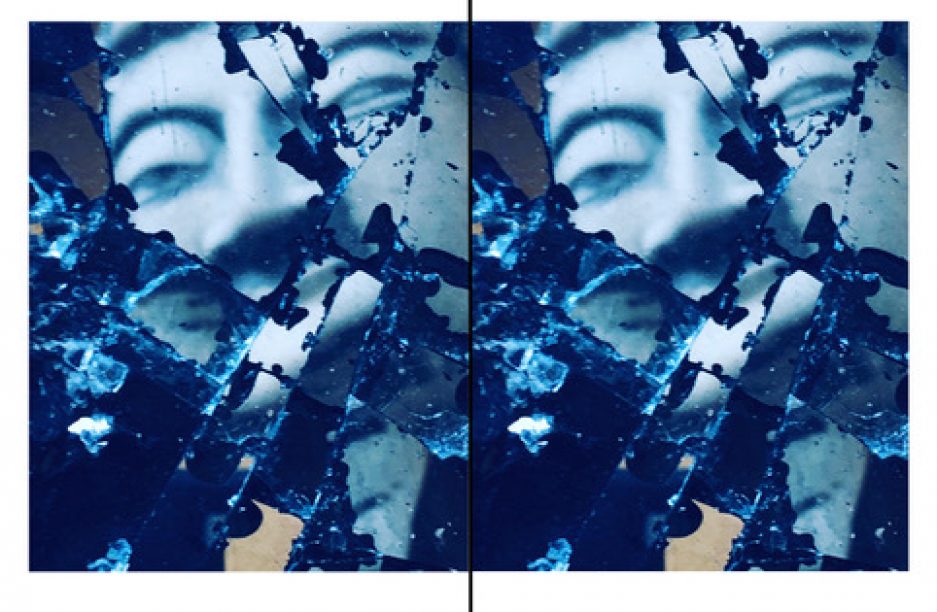
It was a rusty, distinctive, bent fork of a bridge still in use, (this was many years before politicians blew it up in the 1990s) and I took out onto the pedestrian walkway, day or night in any weather, a great place to ramble and carouse. There used to be an abandoned hobo jungle taken over by brambles and briar patches on the eastern fringe of the Missouri. There I would sometimes hike or fish, but mostly I would stop halfway across the river where the vantage and view was best, up or down the river and overlooking the town and waterfront where many of the buildings were a century old or older…even saw a ghost in the river one strange night, the blue-light ghost girl.
There are many ghosts in the lore from old Charlevoix. Some had to do with the river. I glimpsed the blue-light ghost girl with a haunting swirl of pale skin in a blue gown with flowing tresses. Her bare arms and legs were akimbo, drifting in the depths beneath the old bridge in a fuzzy halo that winked in and out in the current. Supposedly the girl was a suicide, or was thrown from the bridge, or maybe a riverboat. But no one told the same story. Like many a folklore apparition the ghost girl was a harbinger of some bad juju. Come to think of it, Charlevoix got hit with a bad flood soon after I saw the ghost-girl, but the Army Corps of Engineers didn’t cite her as the cause, and they are the experts.
Anyway, the floodwater came up over the River Road onto Main Street where my favorite tavern, The Forge, became a veritable island under threat. Some buddies and I sandbagged and holed-up inside for 36+ hours (where the kegs kept us afloat) and we saved the tavern. Later floods, especially in ’93, would erode and wipe out much of old Bangert Island and reconfigure lives. The river always wins.
III
I got just twenty feet from shore where it dawned on me that it was a mistake to take on this particular swim on that particular morning. I was a bobbin tossed into a maelstrom. Eight to ten miles an hour doesn’t sound like much, but the Missouri is the mightiest river in North America. I was a poppet in a log-chute with a wet torpedo up my fundament. It was quickly apparent that I would miss my mid-way driftwood unless I swam like a demon against the current with all the Johnny Weissmuller (with a splash of Buster Crabbe) that I could muster. My fundament (and the rest of me) was keelhauled. My legs and arms were pin-wheeling and fighting the relentless current to no avail.
To this day I do not know rightly how I reached the jutting limb of slippery driftwood. I did, but it broke off in my hand. I held on to it hoping it had enough buoyancy to keep me afloat while I reached down into my heart for the last of my grit. My lungs were gone and swallowed a pint of river. It was mixing with the beer and beef jerky and spewing up into my mouth and sinuses. Then, I felt something large swipe across my hip and thighs, something heavy that a lifted me up a foot or two and got my mind where it needed to be. It had a clammy and abrasive skin and was colder than the water. An alligator gar or a flathead catfish? A sturgeon or a dead body? Or, perhaps the blue-light ghost girl?
Whatever it was it motivated me to kick my legs in burst of fury. I used the paltry chunk of wood as support enough that I managed to steer a vector toward the opposite bank. The closer to shore I got, the current relaxed the hold on me. Eventually I calmed myself and catch my breath. I paddled-boated closer to the far shore where I beached, about a mile and a half downstream of Johnny’s island, went under and past the new bridge and about a hundred yards shy of the old Plank Road Bridge. I was directly across from old Charlevoix Main Street and Monroe. I could see the roofline of my apartment building where I should have been, if I weren’t armed to the teeth with youth and mad as a hatter.
I lay in the thicket and brambles for a spell to right myself. I knew how lucky I had been against the wrath of the river goddess. Must have looked like a drunk on a tear crawling up from the muddy bank and fumbling on my tender feet, wishing I had my sneakers. I trudged up the hobo path toward the ramp and bridge abutment. Traffic was early Tuesday morning rush hour (I’d just had my own) and I didn’t relish the commuters gawking at the near-naked bozo limping into Charlevoix. But screw it! I was alive. So I would prance it and dance it unashamed while hoping a black-and-white squad car didn’t find me. I was somewhat known by the local gendarmes. And my dance-card of chances and lucky breaks was filling. My luck held.
Good old Johnny came to the rescue. His laconic, grinning face, his lanky frame leaning against his vintage pick-up truck, `Sadie’ was parked along the shoulder of the Plank Road waiting on me. I wanted to hug and kiss him, would have if he hadn’t said, “No way you crazy bastard! Get into these duds before you soil Sadie’s seats.”
He tossed me a shirt and pair of his old coveralls. John had surmised my situation when he found my car parked at his shack and tracked me across the island, found my gear and clothes under Buzzard Rock and saw me flailing and clinging to the piece of driftwood, paddling toward the far shore. He rushed back to his shack, told Sheri about my predicament, fired up Sadie and drove through town and across the Plank Road Bridge.
“Figured you’d wash up `round here if you survived the river, you stupid pup. How many times have I warned you about that treacherous river? Have you gone tetched in the head?”
He chided me for an hour and for years after, but mostly we laughed about it all the way back to his shack where Sheri was fixing a hearty breakfast and brewing a pot of coffee. I wish there was a snapshot of her tender look of concern when she saw me alive. It only lasted a few seconds. She hugged the breath out of me, then cussed me until a fly wouldn’t land on me. Before I could sit down for grub and coffee she handed me a bar of soap and a towel, shoved me outside to the mud-hose (under which Seamus got his doggy baptisms). The venerable Seamus watched me skin down to shiver under the cold hose and I swear he was laughing at me. So I squirted him in the whiskers, and together we yipped and barked and danced under the mud-hose like a ripe pair of pagans.
–Dedicated to John, Sheri, and Seamus. And those glory days in old Frogbottom.
Copyright 2018
 R.D. Puller, Scribbler